Free China Website Speed Audit

Your Website Loads Fine in London.
Does It Load at All in Shanghai?

🌐 Real Chromium Browser
📍 Direct Local Connection in Mainland China
📧 Full Report in ~5 Minutes

Two-thirds of foreign websites fail to fully load in mainland China — most companies only find out when a partner tells them. Run a free audit before it costs you a deal.

    The Problem No One Tells You About

    China Doesn't Send a 404. It Just Goes Quiet.

    When your website stalls under China's network conditions, your Chinese buyer sees a blank page or a spinning loader — and closes the tab. No error email. No bounce rate spike. Nothing on your end. You keep sending campaigns into a room where the lights are off.

    2/3
    Foreign websites fail to fully load in mainland China based on a Chinafy 614-site study
    3 min
    Maximum delay one inaccessible Google Analytics tag adds to your page load time
    3 s
    How long a Chinese buyer waits before permanently abandoning a slow page
    Incompatible Services

    Your Stack Did It. Not Your Hosting.

    The most common China website failures are not caused by your server. They are caused by standard Western third-party scripts your team added years ago — and every modern website uses them. China's network environment does not distinguish by brand size or reputation.

    📊

    Google Analytics & Tag Manager
    +10 to 180 sec delay

    🔤

    Google Fonts
    Text invisible on load

    🗺

    Google Maps
    Blank map, layout breaks

    ▶️

    YouTube Embeds
    Video section fails entirely

    👍

    Facebook Pixel & Social
    Delays render, invisible

    🤖

    reCAPTCHA
    Forms hang or won't submit

    💬

    HubSpot · Intercom · Drift
    Chat widget blocks rendering

    🔗

    CDN Scripts from Restricted Domains
    Dependencies fail silently

    Not Just Another Ping Tool

    A Green Checkmark Is Not the Same as a Page That Loads.

    Most free China accessibility checkers send a single HTTP request and report "accessible" if your domain resolves. That takes 200 milliseconds and tells you nothing about how your page actually renders inside a real Chinese browser.

    ❌ Standard Ping / DNS Check Tools
    Sends one HTTP request — not a real browser load
    Reports "accessible" if domain resolves — page rendering irrelevant
    Cannot detect inaccessible third-party scripts (GA, Fonts, reCAPTCHA)
    No screenshot — you cannot see what buyers actually see
    Returns green while your page silently loads in 90 seconds
    No report, no resource list, no next steps

    ✓ VjQj China Audit — Real Browser Test
    Full page load in Playwright — a real Chromium browser, not a ping
    Physical server inside mainland China — standard local connection
    Every request logged: what loads, what stalls, what is not accessible
    Screenshot of your page exactly as a buyer in Shenzhen sees it
    Inaccessible resources identified by category — share the list with your dev team
    Prioritized fix recommendations delivered to your inbox in ~5 minutes

    What You Receive

    What Lands in Your Inbox in ~5 Minutes

    A complete audit report — plain English, no technical background required. No dashboard to log into.

    📊

    China Accessibility Score (0–100)
    Your overall score based on real load time and inaccessible resource count — color-coded with a plain-English grade.

    Actual Load Time from China
    Seconds measured from a Chromium browser inside mainland China. Above 10s means significant drop-off. Above 30s, most buyers have already left.

    🚫

    Inaccessible Resources by Category
    Every script, font, API, or embed that fails to load from within China — grouped by type. Forward directly to your dev team.

    📸

    Page Screenshot from China
    Exactly what your site looks like to a buyer right now. Broken layouts, missing fonts, and blank sections made visible.

    🔧

    Prioritized Fix Recommendations
    Ranked actions based on your site's specific resource issues — not a generic checklist. Know exactly where to start.

    🆔

    Audit ID & Timestamp
    A unique ID per audit so you can re-test after changes and compare before/after scores over time.

    Reading Your Score

    What Your China Accessibility Score Means

    Every audit returns a 0–100 score based on real load time measured from inside China, plus how many resources are inaccessible. No technical background needed.

    ScoreGradeLoad TimeWhat It Means
    90–100⚡ Excellent≤ 3sOpens instantly. Buyers see everything. No action needed.
    75–89✅ Good≤ 10sMostly accessible. A few minor scripts worth replacing before your next campaign.
    60–74⏳ Needs Work≤ 30sVisible delays. Warm leads may wait; cold visitors will not.
    40–59🐢 Poor≤ 120sSerious friction. Most buyers abandon before your page renders.
    1–39🚨 Critical>120sEffectively unreachable. Fix this before any China-facing activity.
    ⚠ ChallengeCDN security layer detected — full evaluation interrupted. Contact us for manual review.

    Most unoptimized foreign websites score between 40–65 on their first audit. Below 60 means buyers are experiencing a broken page — and you will not know unless you test.

    📋 Sample Report

    This Is What You Will Receive

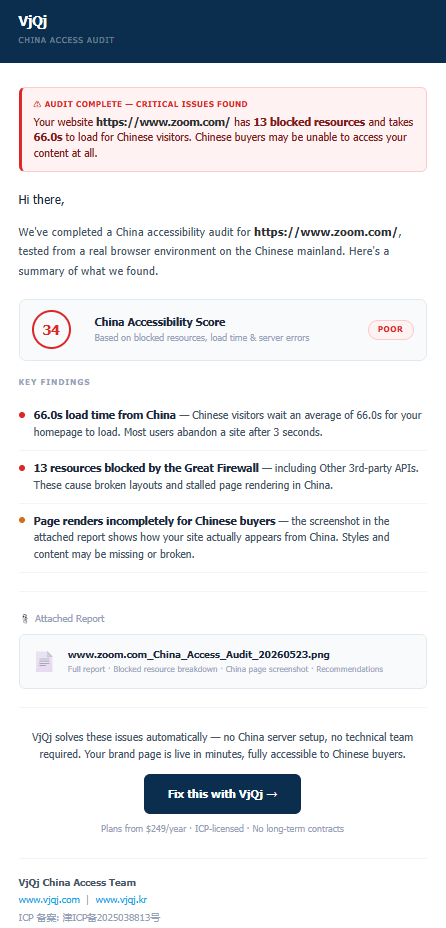
    Score, load time, resource availability list, China screenshot, and fix recommendations — all in one report, delivered to your inbox in plain English.
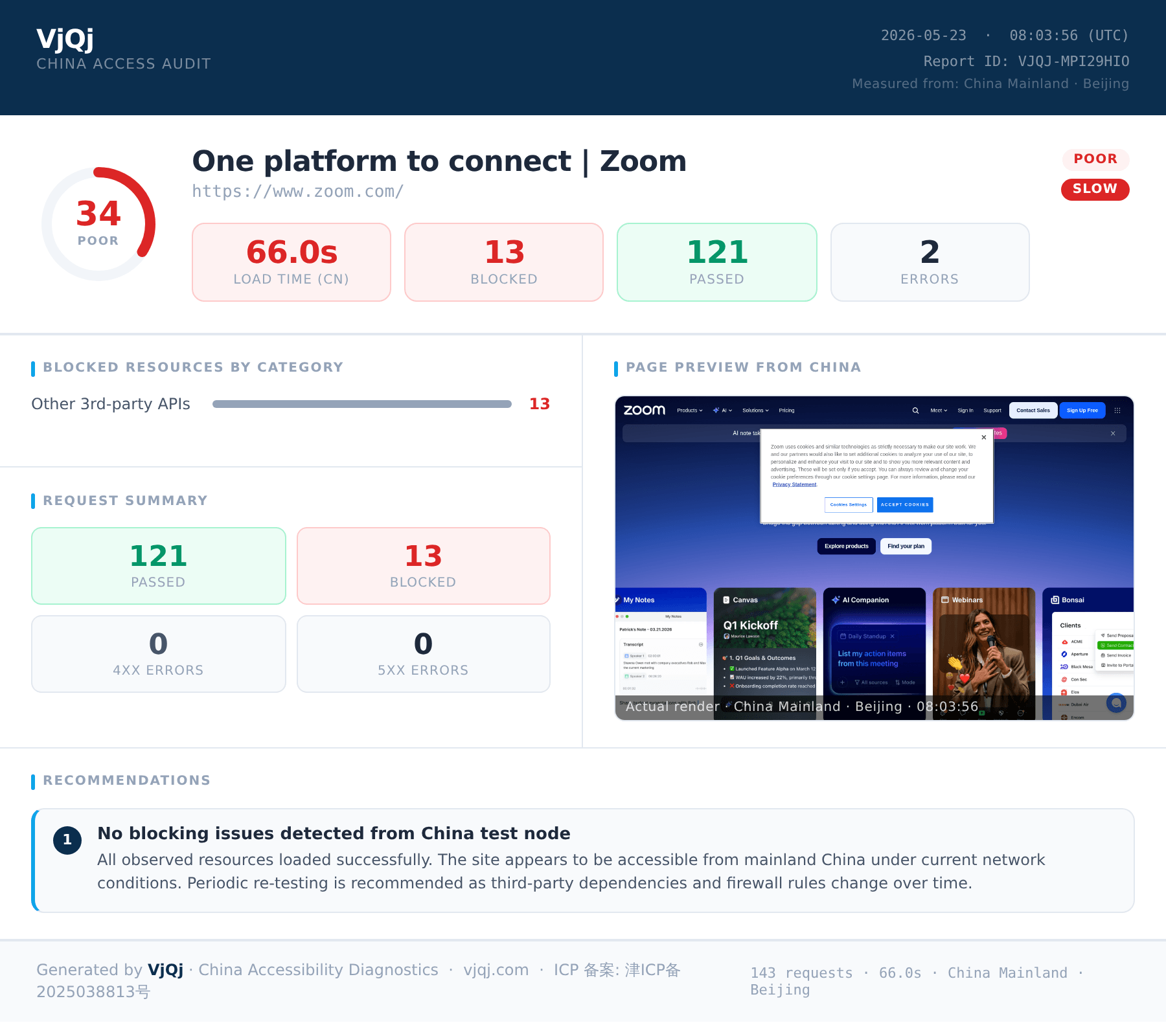
    China Speed Audit — score summary and resource availability breakdown
    China Speed Audit — page screenshot captured from inside mainland China
    FAQ

    Frequently Asked Questions

    Why is my website slow in China when it loads fine everywhere else?
    The cause is almost always third-party scripts embedded in your page — not your server or hosting. Google Analytics, Google Fonts, Google Tag Manager, YouTube embeds, Facebook Pixel, and reCAPTCHA are all standard on modern websites, and are generally not accessible from within China's network environment. When a Chinese buyer's browser tries to load these resources, it waits for a response that never comes — sometimes for up to three minutes per resource. The rest of your page is held in queue. Your server location is usually not the problem. Your script stack is.
    Is Google Analytics accessible from within China?
    Generally not — at least not reliably. Both google-analytics.com and googletagmanager.com are not accessible from within China's network environment. This creates two compounding problems: first, a single GA script that cannot load can add 10 to 180 seconds to your page load — making an otherwise fast website effectively broken for Chinese users. Second, because the GA script never loads, Chinese visitor data is completely absent from your analytics. Your China traffic figures are significantly understated, and most teams never discover this until they run a China-side test.
    Can I accurately test my website's China performance from an overseas connection?
    Not accurately. Testing from an overseas connection means you are seeing the page from outside China's network environment, not from within it. China's network environment behaves differently at different entry points, and traffic originating outside may not encounter the same conditions that a real Chinese user experiences. The only reliable way to see what a buyer in Shanghai sees is to load your website from a real browser, on a real device, from inside mainland China, on a standard local connection. That is what this audit does.
    Does Cloudflare or a CDN fix the China problem?
    Partially, but not fully. A CDN reduces physical distance between your server and your user — which helps with raw latency. It does nothing to fix inaccessible third-party resources. If your page loads Google Fonts from fonts.googleapis.com, Cloudflare cannot make that domain accessible inside China's network environment. Similarly, CDN edge nodes in Hong Kong — a common recommendation — are not inside mainland China's network environment and do not accurately replicate the buyer experience. The audit identifies which specific resources are causing problems, so you can fix the right things instead of guessing.
    Why are certain overseas services not accessible within China?
    China operates its own national internet infrastructure, which means that some overseas-hosted services and domains are not accessible from within the country's network environment. For foreign websites, the practical impact is: any resource your page requests from a domain that is subject to network-level restrictions will timeout or fail — the browser waits silently with no error shown to the user, and no notification sent to you. Your page then loads slowly, partially, or not at all. Network conditions can also vary by city, ISP, and time of day. Testing from one location only captures part of the picture.
    How is this different from GTmetrix, Pingdom, or other speed test tools?
    GTmetrix and Pingdom are general performance tools with no servers inside mainland China. They do not test from within China's network environment. A site that loads in 0.8 seconds from their US nodes can take 90 seconds from Beijing — and GTmetrix will show it as "fast." The VjQj China Audit specifically tests from inside China using a real Chromium browser, measures actual load time under China's network conditions, identifies which resources are inaccessible by name, and provides a screenshot of what Chinese users actually see. These are fundamentally different outputs.
    Do I need an ICP license to improve my China score?
    No. An ICP license is only required if you want to host your website on servers physically inside mainland China. Many foreign websites achieve a good China accessibility score without one — by removing or replacing incompatible third-party scripts. The audit shows your current score and what is causing the most friction. For brands that want a fast path to China-accessible performance without the ICP filing process, VjQj offers an alternative infrastructure approach that does not require hosting migration.
    What does "tested from inside China" actually mean technically?
    The audit uses Playwright — a real Chromium browser — running on a server physically located inside mainland China, connected to a standard Chinese ISP, on a standard local connection. The browser operates within the same network environment as a real Chinese user. Every resource request your page makes is logged: which succeed, which timeout, which are not accessible, and how long the full page takes to render. A screenshot is captured at the end of the load cycle. This is the same methodology used by enterprise website monitoring services — not a DNS check, not a ping.
    What can I do to actually fix a low score?
    Your report includes a ranked action list based on your site's specific problematic resources. The highest-impact fixes are: self-host Google Fonts (serve font files from your own domain instead of fonts.googleapis.com); replace Google Analytics with a China-compatible alternative like Baidu Tongji or a self-hosted Matomo instance; and load third-party scripts asynchronously so they do not block page rendering. For teams that need a faster path, VjQj can deploy a China-ready brand page that bypasses these issues entirely — no ICP filing, no server migration required.

    Score Below 60? Skip the Six-Week Dev Sprint.

    Fixing a low score the traditional way means removing scripts, finding replacements, testing across environments, and dealing with dev queue time — typically weeks. VjQj deploys a China-accessible brand presence in days, with no ICP filing, no server migration, and no technical work on your side.

    See How VjQj Fixes This →

    Free · Real Chromium Browser · Mainland China · Direct Local Connection

    Find Out in 5 Minutes What Chinese Buyers See Right Now

    Enter your URL. Get your score, load time, resource availability list, screenshot, and fix recommendations.